The murder of Father Gorman after visiting Mrs Davis
The Pale HorseThe murder of Father Gorman after visiting Mrs Davis turns a private record into the one clue the attacker leaves behind. Father Gorman is struck down after preserving a list of names in his shoe; when the police examine the killing, that overlooked scrap of paper complicates the apparent simplicity of the attack and points the inquiry toward what he had been carrying.
The memorandum and the concealed list
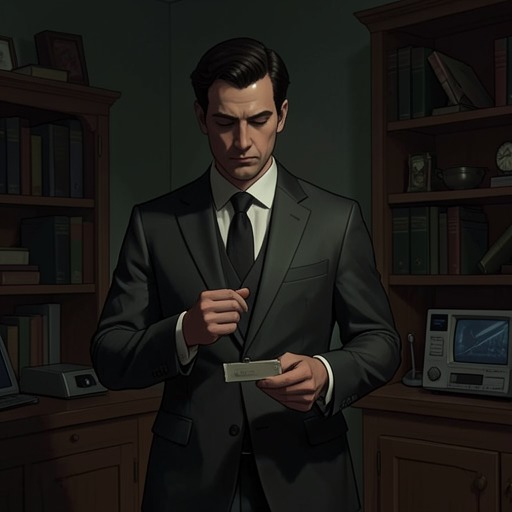
After visiting Mrs Davis, Father Gorman takes a torn piece of paper and begins writing. The names matter enough that he is concerned about forgetting them, a small but consequential detail: the list is not an incidental note but something he has deliberately assembled and wants to keep. The evidence does not disclose what the names mean at this point, so their significance remains an open question rather than an answer.
The paper is flimsy and creased, and Father Gorman has a practical reason for choosing where to put it. Remembering the hole in his pocket, he folds the scrap and presses it into his shoe, a place he has used before. His ordinary solution to a familiar problem becomes decisive after his death. Whoever attacks him does not find the list, and the information he meant to preserve remains available to the police.
The attack on the street
At the cafe, three young men in Edwardian dress arrive noisily. Another man enters quietly and sits in a far corner. Father Gorman drinks a little weak coffee, asks for his bill, pays, and leaves. The newcomer then looks at his watch as if he has misjudged the time, gets up, and hurries out. The sequence places him behind Father Gorman without establishing, by itself, who he is or what he intends.
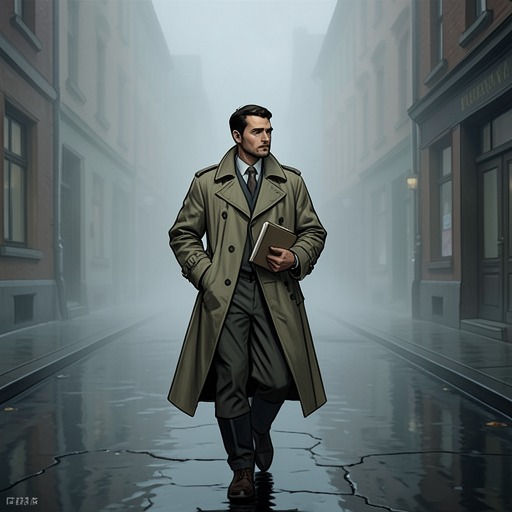
Fog is coming on quickly as Father Gorman walks through a district he knows well. He takes a shortcut along a small street near the railway. He may be aware of footsteps behind him, but the possibility does not alarm him; he has no reason, as far as he understands, to expect danger. The attack therefore comes without warning. A blow from a cosh knocks him forward, and he falls. The account gives the essential action plainly, without identifying the assailant or supplying a motive.
What the police find
Dr Corrigan reports the medical finding to Divisional Detective-Inspector Lejeune: the blow was severe, the first probably fatal, and the assailant struck again to make sure. The assessment establishes that Father Gorman was deliberately killed, rather than accidentally injured, while leaving the killer’s identity unresolved. Lejeune’s attention turns to what may have been taken. Robbery seems unlikely, but something was left behind in Father Gorman’s shoe.
Lejeune retrieves the flimsy, creased paper from a drawer and identifies its contents as a list of names. That discovery changes the meaning of the scene. The attacker had left behind something potentially important, whether through ignorance or because the paper was not the object sought. Lejeune considers both the list and the possibility that the assailant was after a small amount of money; the evidence at this stage does not settle which explanation is correct. The list’s survival is a concrete investigative opening, not yet a complete solution.
Narrative and investigative significance
The event links concealment, pursuit, and investigation through one modest object. Father Gorman’s habit of putting a folded scrap into his shoe saves the list from being removed with his other belongings. The police then move from the circumstances of the killing to the document he carried, while its unexplained names invite the question of why they mattered. The attack is thus both a death and the beginning of an inquiry organized around an incomplete record.
The scene also withholds certainty in carefully limited stages. The quiet cafe visitor leaves after Father Gorman; footsteps may follow him; the street attack is sudden; and the list is discovered only in the subsequent police discussion. These details make suspicion possible without proving every link. The murder’s decisive consequence is that Father Gorman cannot explain his memorandum, but the paper he hid survives to carry that unanswered question into the investigation.